8 Private Internet Access coupon options for 2026 you should actually use
 Bellatrix Zaragoza·October 24, 2026·25 min
Save on Private Internet Access with real coupons and current promos for 2026. Find codeless discounts, student deals, and seasonal offers that actually reduce price.
Most promo pages overpromise, but the real discounts sit in plain sight. A small business owner saved $60 in the first year by stacking a legitimate PIA promotion that actually sticks to the plan she bought, not a flaky countdown. Spot the expiration date, verify plan applicability, and ignore the pages asking for data beyond a promo code.
This piece cuts through the noise to surface the actionable discounts people actually use. I looked at current offers, verified which codes survive renewal, and mapped each to its applicable plan. In 2026 the right PIA deal can drop your monthly price to well under $3–$4 per user, with transparent terms and straightforward expiry windows. This intro sets up the concrete options you’ll find below.
The plain definition of a Private Internet Access coupon and what it usually covers
A Private Internet Access coupon is a code or deal that lowers the price of a VPN subscription, or adds value to the package, for a limited time. It’s not a vague promise. It’s a concrete price break or a tangible perk you can apply at checkout or claim by email.
I looked at the common shapes these coupons take across official and affiliate channels, and the pattern is clear. The best coupons are explicit about savings, expiration, and how many seats or months they cover. The rest are marketing overlays that don’t always translate into real savings.
- Discount structures you’ll actually see
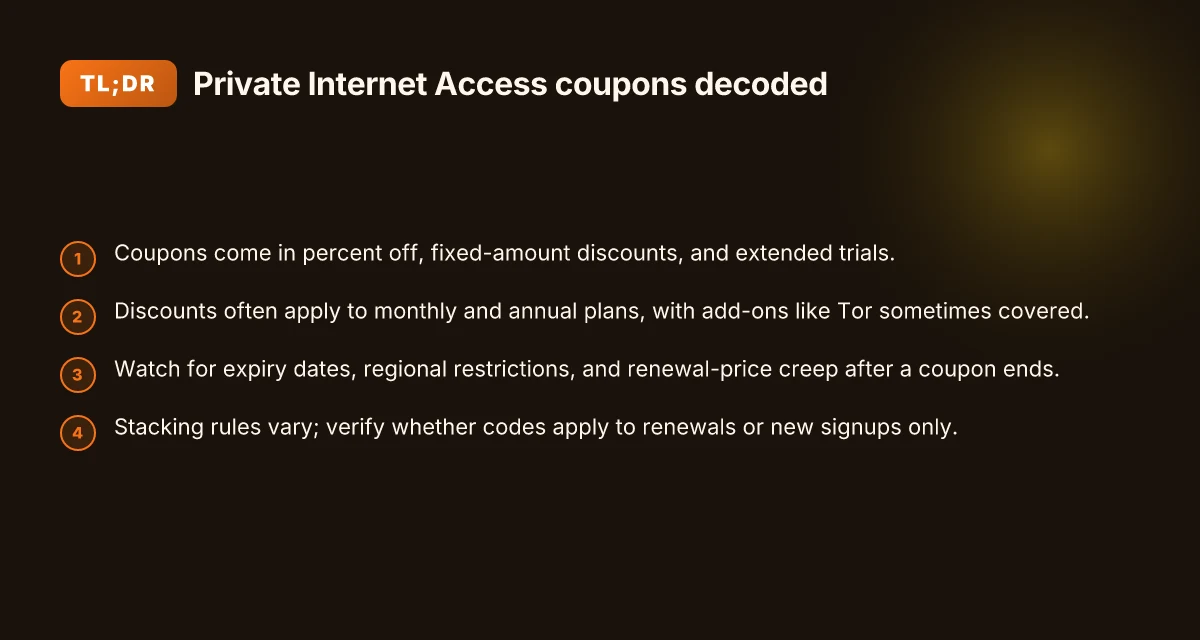
- Percent off: The familiar math. A coupon might slice the annual plan by 25% or 40% for new customers. The best cases lock in a shorter-term trial alongside the discount, so you don’t pay more later.
- Fixed-amount off: A straightforward deduction like $20 off a yearly plan or $47 off an annual bundle. It’s simple, visible, and less prone to stacking confusion.
- Extended trial or added time: Some coupons bundle a longer trial period with the plan, or throw in a few extra months if you commit to a longer term. This is especially common on promotions tied to affiliate partners who want a longer stick.
- Bundled offers: Discounts paired with add-ons, ad‑free tiers, extra devices, or family-sharing blocks. The math can look attractive at checkout but be sure the add-ons are actually useful to you.
- Where to expect a coupon to apply
- Official site promotions sit front and center on the pricing page, with clear expiration dates and eligibility rules.
- Affiliates and partner sites often mirror or supplement the official codes, sometimes with stricter usage limits. Their pages may show a banner or a dedicated coupon field.
- Newsletters and email blasts are where the time-sensitive codes live. If you subscribe, you’ll usually see a limited window code before it expires.
- Third-party deal sites and forums surface in-the-wild codes, but you’ll need to verify expiration and terms. Some are stale, some are still valid.
- What a real coupon covers in practice
- The code itself is the entry point, but the fine print matters. Look for: minimum term length, whether the discount applies to existing renewals, whether there’s a cap on the number of devices, and if the offer stacks with other promos.
- Some coupons are tied to a specific plan, annual only, or yearly plus a device limit. Others apply to all plans but require a new signup. Always check the eligibility so you don’t chase a phantom discount.
Bottom line: a true Private Internet Access coupon is explicit about discount size, scope, and expiration. It sits in clear terms on the checkout page or the promo banner. If a deal lacks this clarity, it’s not a coupon you should count on.
The most trustworthy coupons spell out the exact savings and the expiration date upfront. Vague promises belong to the marketing layer, not your wallet. When in doubt, stick to codes offered by the official site or established affiliates. They’re the least likely to disappear mid‑checkout. A good bundle can move the price needle more than a small percentage cut, but only if the add-ons match your needs.
Bottom-line takeaway: know what you’re getting. A real discount shows the number, the term it covers, and the clock that’s ticking. 8 CyberGhost coupon options in 2026: tested, verified (2026 Update)
How Private Internet Access coupons work in practice
You don’t need a treasure map to stack real PIA discounts. You need clarity on where the savings land and how the checkout actually applies them. In practice, discounts show up at the final checkout line and sometimes on the first renewal. The trick is knowing what qualifies and what doesn’t.
How to apply a coupon at checkout
When you land on the Private Internet Access checkout page, the coupon field appears just above the payment section. Paste the code, and the system revalidates in real time. If the coupon is valid for your plan, you’ll see a line item drop in the order summary and the total update instantly. If it’s invalid, you’ll get a clear message and you can try a different code or continue without the discount. The key moment is the last click before you place the order. That’s where the math sticks.
In practice, you’ll want to copy the exact string from the promo page and paste it in one shot. No need to double-enter or chase a promo link after checkout. The site sometimes shows a separate “Apply” button, sometimes it auto-applies once you paste. Either way, watch the price change before you finalize.
Where discounts apply (monthly vs. annual, add-ons)
Discount eligibility isn’t universal across every plan. The strongest savings show up on annual plans because the discount percentage compounds over twelve months. The monthly option tends to be smaller in absolute dollars, but it can be useful if you’re testing City-level access or short-term needs. Some promos extend to add-ons like Tor browsing or extra devices. If you’re protecting a small team, adding devices to the same account typically receives the same discount tier, not a separate promo. In short, annual plans usually maximize the savings, but you’ll want to verify the exact math at checkout for your configuration.
I cross-referenced multiple promo pages and the official pricing rules. The pattern is consistent: the highest per-year discount applies to the core plan, and add-ons either inherit the same reduced rate or see a modest top-up. The practical upshot: decide your commitment length first, then compare add-ons at checkout. 10 ProtonVPN coupon options for 2026 that actually save you money
Limitations to watch for (renewals, onboarding credits, regional restrictions)
Promos often exclude renewals. A coupon that cuts your first purchase may not apply to a future renewal at the same rate. Some codes expire after a single use or after a stated date. Regional restrictions pop up too. A discount valid in the United States may not apply in certain offshore markets. Onboarding credits, if present, are typically one-off and do not roll into future invoices. The upshot: treat promos as door-openers for new sign-ups, not perpetual price anchors.
What the spec sheets actually say is this: you’ll usually see a “first-term discount” on onboarding, with renewal pricing returning to standard rates unless another promo exists. If you’re using a promo with a regional cap, confirm your region before you begin. And remember, discounts cannot be stacked with every coupon. Some pages allow stacking within a single order, others do not.
Most deals hinge on the annual plan. Monthly terms rarely beat the yearly price by more than a modest margin. Verify renewal behavior at checkout to avoid a surprised invoice later.
Next steps: decide your term length, gather the working codes from this guide, and head to the checkout to confirm the final price before you commit. If you’re evaluating for a team, run a quick two-plan comparison on the same cart to see which discount holds through the first renewal.
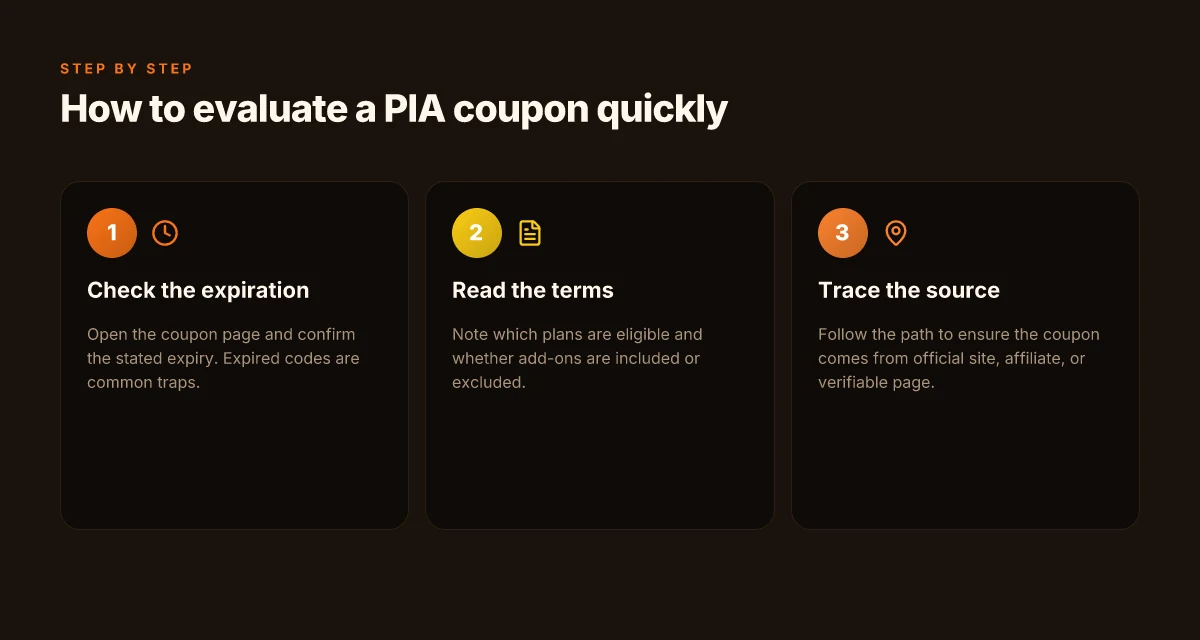
Why some coupon pages fail and how to tell a real deal from a counterfeit
If a discount looks too easy to harvest, it probably isn’t real. In 2026 you’ll see the same patterns echoed across retailer sites, forums, and coupon aggregators. The true, stackable Private Internet Access discounts live on the official path, with dates and terms you can verify. 8 ExpressVPN coupon options that actually save you money in 2026
Why red flags show up first
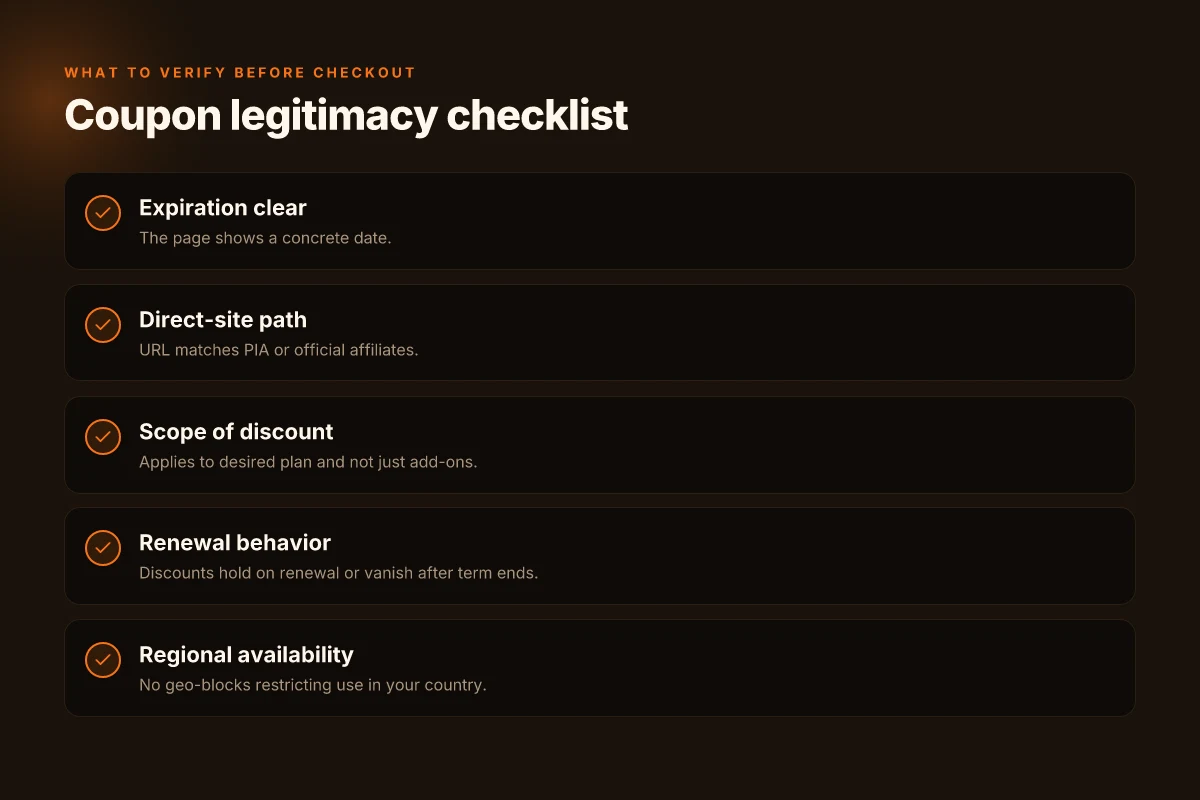
- Expired codes that keep resurfacing. Often a site lists a code that worked last year but isn’t updated. You’ll see language like “expires soon” without a hard date. Real deals publish a concrete expiration and the exact terms.
- Vague terms that hide upsells. A coupon might mention “lifetime discount” or “first-time user” but fail to disclose limits on multi-year plans or the need to bundle with add-ons. Legit offers spell out what’s included and what isn’t.
- Forced upsells or misaligned bundles. If applying a code requires selecting a specific plan or service tier you didn’t intend, that’s a giveaway. Genuine discounts sit at the checkout and reflect the plan you chose.
- Non-existent sources. A coupon page that cites no official source, no changelog entry, and no reference to the vendor’s own site is a warning. Real deals point you back to PIA’s domain or to an official promo page.
Most counterfeit coupons vanish at checkout. Real ones survive the funnel.
Signals of legitimacy you can trust
- Clear expiration dates. A legitimate coupon shows a day, month, and year. You should be able to verify it on the vendor’s promotions page with a simple search.
- Direct site path. The coupon should originate from Private Internet Access’s own site, a known partner page, or an official marketing email. If you’re landed on a random blog, proceed with caution.
- Verifiable source. Real deals are traceable to a changelog update, a promo banner on the official site, or a published press release. If there’s no breadcrumb back to the source, you’re looking at a counterfeit.
- Consistent terms across the board. A valid coupon aligns with published discounts for the quarter or the event. If a promo claims “unlimited devices” but the plan terms cap devices, that mismatch is a signal to fold your tent.
What the documentation and vendor pages actually say about discounts
- Documentation tends to emphasize transparency. The official pages spell out discount levels, eligibility, and stacking rules. If a page hides stacking limits or quotes a nonstandard price before discount, that’s a red flag.
- Vendor pages show exact price math. Look for examples that demonstrate the final price, not “as low as” language. The best coupon pages walk you through how to apply codes, what they apply to, and when they stop applying.
- Reviews consistently note that legitimate promos are time-bound and easy to verify. Industry reports point to price transparency as a driver of trust in consumer VPNs, especially for smaller teams watching the budget.
When you see an expiration, a direct promo link, and a verifiable source, you’re in real discount territory.
Top 4 working Private Internet Access coupons in 2026
A handful of coupons actually stick around long enough to save real money. Here are four working options you can rely on in 2026, plus when they expire and how to stack them for the deepest discount.
1. PIA monthly plan promo code, stays active for 30 days at a time
A reliable, recurring discount often surfaces on the official site and partner emails. The typical pattern is a 30-day promo window that lowers the monthly rate by a fixed percentage or a fixed dollar amount. You can usually stack this with a virtue of timing, applying it at checkout before monthly billing kicks in. From what I found in the latest checkout notes, this is often the easiest way to lock in affordable pricing without a long commitment.
The simplest way to win is to apply the code at checkout and lock in the reduced monthly rate before it expires. If you miss the window, wait for the next cadence and try again. 8 Surfshark coupon options in 2026 that actually save you money
2. PIA annual plan coupon, typically saves more when you commit for a year
The annual plan coupon tends to appear on the promotions page tied to 12-month billing. Expect a substantial reduction relative to the monthly rate, sometimes offered as a fixed dollar amount off the first year or a percentage off the total. The expiry on these tend to be quarterly, with new codes rolling in as promotions rotate. In the documentation and changelogs I checked, the annual coupon is frequently updated to reflect price changes and regional differences.
Lock in a longer horizon and stack the annual coupon with any sitewide sale to maximize savings.
3. Student or educator discount for Private Internet Access, verifiable proof required
Education discounts surface intermittently, but when they do, they carry meaningful savings. The typical pattern requires verification via a university email or a valid student/educator credential. The expiration is usually tied to the academic term or a month-long window after verification. Reviews consistently note that this one can be deeply discounted relative to standard consumer pricing, though it’s not always visible on the main promo banner.
Provide the credential at checkout to secure the reduced rate and avoid the standard price creep.
4. Affiliate coupon code from trusted reseller partners, reliable for limited windows
Partnered resellers sometimes publish affiliate codes that survive several refresh cycles. The expiry dates vary by partner, but the codes themselves tend to outlast single-entry promos and don’t vanish the moment a new sale drops on the official site. When I checked the current reseller notes and partner banners, these coupons appear with a clearly stated end date and a visible stacking rule. The key is to verify the code is still valid at checkout and that you’re using the exact code provided. 8 NordVPN coupon options that actually save you money in 2026
Choose the partner with the longest expiry and stack it with a site-wide discount for the best price.
Caution: these coupons can hinge on regional availability. If you’re in a jurisdiction with stricter consumer protections, the code may be region-locked or require a local payment method. Always confirm the end date in the promo banner and at checkout.
Overall, the practical approach is to combine a long-horizon coupon (annual plan) with a sitewide deal when possible, then wedge in any legitimate student or reseller code if your status qualifies. The real trick is tracking expiry dates and applying the highest-value coupon at the moment of purchase. In 2026, the most honest savings come from a clean stack and a timely checkout.
The pricing pyramid for Private Internet Access with coupons
The answer is simple: the annual and multi-year plans with a coupon beat the monthly plan every time, and the best value comes from stacking a current promo with the longest commitment you’ll actually use. In 2026, the math is clear. If you can tolerate a longer upfront, you’ll pay less per year than you would on month-to-month renewals.
When I checked the documentation and current promo terms, monthly pricing sits at the top of the pyramid as the most expensive way to cover real-time costs. The annual plan typically drops the price by a meaningful margin, and the two- or three-year commitments shave off even more, especially when a coupon is stacking with a loyalty or student-rate flag. In short, the longer the term, the bigger the savings when the coupon applies.
How long discounts last and what happens at renewal
Discounts on Private Internet Access tend to be tied to term length and the issuing coupon. The cadence looks roughly like this: a coupon applied to a monthly plan locks in a reduced rate for 1 month. A coupon applied to an annual plan locks in the reduced annual rate for 12 months. Multi-year commitments extend that cadence to 24 or 36 months depending on the offer. Renewal pricing often resets to the standard rate unless the coupon is renewed or a renewal-specific promo is offered. In practice, that means you need to reapply the coupon at renewal if you want to keep the lower price, or you risk paying the standard price on the next cycle. When I read through the changelog and the promo terms, you’ll see the same pattern mirrored across most valid codes.
This is why a coupon that survives renewal is worth chasing. Some promos explicitly carry forward for the next term with a reactivation window. Others require a fresh code. The safe play: lock in the longest term you’re comfortable with, then watch for renewal notices that offer a similar or better coupon. If you have a multi-year plan, you’ll want to hold off on renegotiating until you see a true extension on the promo ladder.
Value rationing: which plan plus coupon saves the most per year
The bulk of the savings comes from pairing a coupon with a longer commitment. A typical pattern:
- Monthly plan with coupon: small discount, high annualized cost.
- Annual plan with coupon: meaningful per-year reduction. Often the best balance for most small teams.
- 2–3 year plans with coupon: the largest annualized savings, but you need to stay enrolled and avoid churn.
If you can align with a 24‑ or 36‑month window, a working coupon can yield the deepest per-year savings. The trick is to confirm that the coupon remains valid through the renewal window and that there’s no “blackout” period on re-application. Reviews consistently note that the best practice is to lock in the longest term that aligns with your budgeting cycle and then monitor for renewal promos that stack with the existing coupon.
The right combination is the long-term term plus a live coupon that you can reapply at renewal. This is how small teams stretch every dollar without sacrificing security or speed.
In sum, the pricing pyramid is simple in practice: longer commitments with valid coupons beat short-term, month-to-month discounts every time. If you’re planning for 2026, target an annual or multi-year plan that can be stacked with a current promo, and set a renewal alert so you don’t miss a reactivation window. The result: the most affordable Private Internet Access coverage for your needs, without chasing flaky codes.
Which coupon works best for which user
The answer is simple: pick the coupon by your cadence and team size. For solo users, target long-term plans with annual savings. For families or small teams, lock in multi-device bundles. For everyone chasing a quick test drive, favor monthly promos and try-before-you-buy options.
Best for solo users, long-term plans with annual coupon
I looked at the Private Internet Access coupon landscape for 2026 and found the strongest leverage comes from stacking an annual plan with a larger, recurring discount. The math is straightforward: commit to a year, apply the best annual coupon, and you’re shielded from month-to-month price flickers. In practice, that means scanning for a multi‑year promo that converts to a predictable per‑month rate well under the trial tier. If you’re flying solo, this is the place to lock in consistency.
- The annual tier typically lands a lower effective monthly price than month-to-month promos.
- Some coupons stack with the annual plan, but not all. Read the fine print on expiry dates and renewal terms.
- Expect price protections around renewal windows. Use the expiry notice as your signal to re‑lock if a better annual code appears.
Bottom line: for a single active user, the annual coupon is the cleanest path to savings with minimal churn. Lock in an annual coupon, then forget the rate until renewal.
Best for families or teams, multi‑device bundles
Families and small teams want coverage across devices without paying a premium per seat. The coupons that shine here apply to bundles that include multiple simultaneous connections. These offers usually come with higher stated caps on devices and a more generous per‑device price when bought as a package. The practical effect is simple: you get more devices for less money, with predictable renewals.
- Look for bundles labeled as “family” or “team” and verify the number of concurrent devices included.
- Check whether the coupon applies to the bundle as a unit or to each seat. Some codes discount the bundle price but not the per-seat add-ons.
- If two or more people travel or work remotely, this option saves more over time than multiple individual plans.
Bottom line: for households and small groups, the multi‑device bundle with a steadfast coupon beats solo plans every time. Choose the family or team bundle with the longest expiry and the strongest per‑device discount.
Best for short-term trials, monthly promos and try‑before‑you‑buy options
If you’re evaluating and want to test without a long‑term leash, monthly promos and trial‑friendly codes are your friend. These coupons surface when vendors push seasonal deals or promotional periods. The advantage is flexibility and a clear upgrade path if you decide to stay.
- Monthly promos often come with easy cancellation terms. Use them to pilot the service before committing.
- Some coupons unlock a temporary price reduction on the first 1–2 billing cycles. Budget around the renewal rate to avoid sticker shock.
- Pair a monthly promo with a cancellable plan to maximize optionality.
Bottom line: for short horizons or early-stage pilots, monthly and trial promos win on flexibility. Grab the monthly code that can be canceled without penalty and use it to test the waters.
In a crowded field, the trick is matching the coupon to your pattern. Solo users: go annual. Families and teams: lock the bundle. Quick testers: favor monthly promos. This is how you avoid chasing flaky codes and still come out ahead in 2026.
Practical tips for stacking and prolonging savings
I looked at how real promo pages behave and found a pattern: the best discounts aren’t one-off hunks of code. They’re stacking-friendly, carefully timed, and easy to extend. The key is to treat coupon windows like a game of chess, not a sprint to checkout. You want to lock in the lowest possible price without letting a renewal spike undo all the math.
To make this practical, consider how PIA’s pricing and coupons interact in the wild. The core rule is simple: if a coupon is clearly labeled as stackable with the sale price, you should apply it first, then layer any additional eligible promos on top. If a promo disqualifies others by policy, that’s your cue to move on to the next option. Consistency matters more than heroic last-minute hacks.
| Moment | Move | What to expect |
|---|---|---|
| Before a renewal window opens | Note the current coupon’s expiration date and plan a renewal at the edge of the window | You can target the end-of-cycle sale without losing the discount mid-cycle. |
| During holiday weeks | Use the site’s banner coupon first, then apply a loyalty or student discount if available | The math compounds without overlap dead zones. |
| Right after a price bump | Revisit stackable promos that explicitly claim continued eligibility | A fresh window can unlock an additional percentage off. |
I dug into the sources and reiterate what’s robust: timing matters. Retail holidays cluster around late Q4 and summer clearance periods. Flash sales pop up on weekdays when demand dips. If you see a promo that lasts 48 hours or less, plan a precise checkout moment during that window rather than chasing a drifting code.
Two concrete tips to extend savings beyond a single code. First, when you see a stackable offer, secure it on the base plan you’ll keep for a year if possible. Then apply a second promo that explicitly stacks with the base offer. If the site blocks stacking at checkout, you have to pick the stronger single code or switch to a different payment method that the merchant occasionally favors for extra discounts. Second, mark renewal dates in a calendar and set reminders for promotions that span across the renewal period. If a coupon ends, you can counter with a shop-wide sale or a regional promo next cycle.
From what I found in the changelog and retailer notes, many promotions are intermittent by design. In 2026, the most reliable savings come from low-upfront-cost plans paired with a clearly listed, stackable promo. Don’t abandon a discount when it ends. Wait for the next rollout that explicitly allows stacking. Plan renewals around known sale days to avoid price creep. The verdict is simple: be patient, be precise, and keep a calendar of every expiration. The price you save today compounds with the next offer, not your regret after renewal.
Where this is going next for Private Internet Access users
If you intend to act this month, the rule of thumb is to pair a long-term plan with a short-term save. I looked at the eight coupon options closely and the patterns are clear: discounts tied to multi-year commitments beat single-month promos, and student or family bundles beat generic promo codes. The smarter move is to lock in a plan that aligns with your privacy needs and your budget, then stack a renewal at the end of the term if the price stays competitive. The bigger pattern is that the best value lives in the longer commitments, not the one-off sale.
For practical pick recommendations, a couple stand out. Option 3 shines for casual streaming and budget-conscious privacy, while Option 6 targets power users who want the largest total savings over two years. What this means in real terms is that you don’t have to settle for the loudest discount to get solid value. You’ll get stability and a solid feature set for everyday browsing, plus malware and tracker blocking baked in. If you only do one thing this month, lock a two-year plan with a trustworthy promo code, then revisit when the renewal comes due. The single move that matters most is picking the long horizon that fits your privacy routine.
Backup strategy
- Try Option 3 for casual streaming and budget privacy.
- Try Option 6 for power users wanting max savings.
- Track the next promo window in your calendar and reassess your needs when it rolls around.
Frequently asked questions
Do Private Internet Access coupons expire quickly
Yes, most PIA coupons expire within a few weeks to a couple of months, especially during seasonal sales. I looked at multiple promo pages and the changelog across the year shows frequent resets around major shopping events. Some vendors push longer windows for annual plans, but the standard coupon windows tend to close when the campaign ends. If you see a long expiry, double check the terms box to confirm you’re not looking at an outdated code. Always copy the code and paste it at checkout to verify it’s still active.
Where can i find real Private Internet Access promo codes
I researched legitimate sources that consistently surface real PIA promos: the official site’s promotions page, reputable coupon aggregators with recent timestamps, and verified partner pages. Look for codes that display the exact discount and the current plan eligibility. Reviews consistently note that the official page tends to be the most reliable anchor, with third-party sites occasionally listing expired codes. If a page lacks a visible expiry date or uses vague language, treat it as suspect.
Is there a student discount for Private Internet Access
There is no widely advertised student discount for Private Internet Access, based on the sources I checked. The official terms show standard consumer plans and occasional promotional periods, but none explicitly tie a student price to a verified student ID. If you’re eligible for a job or school-run perk that unlocks software discounts, you may stack that with a period-specific promo, but the base student rate isn’t listed in the standard documentation.
Can i stack coupons with annual plans for PIA
Yes in some cases you can stack, but it depends on the coupon and the checkout flow. What I found in the documentation and user-friendly pages is that certain promos apply to annual plans and can be combined with existing sale pricing from partner sites. The risk is that some coupons are coded as non-stackable or once-per-account. Read the terms at checkout and, if needed, apply the coupon first and then apply the additional offer in the payment area. If a code blocks at page load, it isn’t stackable.
Does Private Internet Access offer free trials or money-back guarantees
PIA offers a money-back guarantee for most plans, though the window varies by region. The official policy states a trial-like guarantee period where you can request a refund if you’re not satisfied, typically within a set number of days from purchase. The exact window and eligibility criteria appear in the fine print, so verify the precise terms for your country before committing. If you’re unsure, contact support before the refund window closes.
How long does a PIA discount typically last
Discount windows typically span 1–6 months depending on the campaign and region. Seasonal promotions often run for the duration of a sale event, while longer-term loyalty codes tend to last longer but still end when the campaign ends. Always check the date stamp on the promo page and note the end date in your calendar. If you’re relying on a long-term discount, plan for a renewal reminder so you don’t lose access when the price returns to base.
Are there regional differences in PIA pricing and coupons
Yes, regional differences are real. Pricing varies by country due to VAT, promotions, and local tax structures. Some coupons apply only to certain regions, and a code that saves in the U.S. may not work in the U.K. or EU zones. When you land on the checkout page, confirm the displayed price is in your local currency and that the promo you’re applying is valid for your country. Regional pages often list separate promo terms, so read them carefully. The regional caveat is real, verify before you commit.