8 TunnelBear coupons to save on VPN this year
 Anya Ashworth·October 26, 2026·23 min

Save on VPN with real TunnelBear coupon codes for 2026. We break down current offers, how to apply them, and what to expect from each deal.
Most savings from TunnelBear coupons vanish when you don’t align with the regional rules. A $47/year bundle in one market can sting in another, and the stacking math often breaks the terms anyway. The real gain comes from knowing which promo actually applies to your use case and when.
Small teams, students, and travelers should plan like this: identify the exact TunnelBear offer, verify regional eligibility, and map the expiration window before you commit. In 2026, the most meaningful cuts come from understanding how often authentic student or bundle promos show up and how to combine them without triggering red flags. This piece dissects the common traps and shows where the real money sits.

The plain truth about TunnelBear coupons in 2026
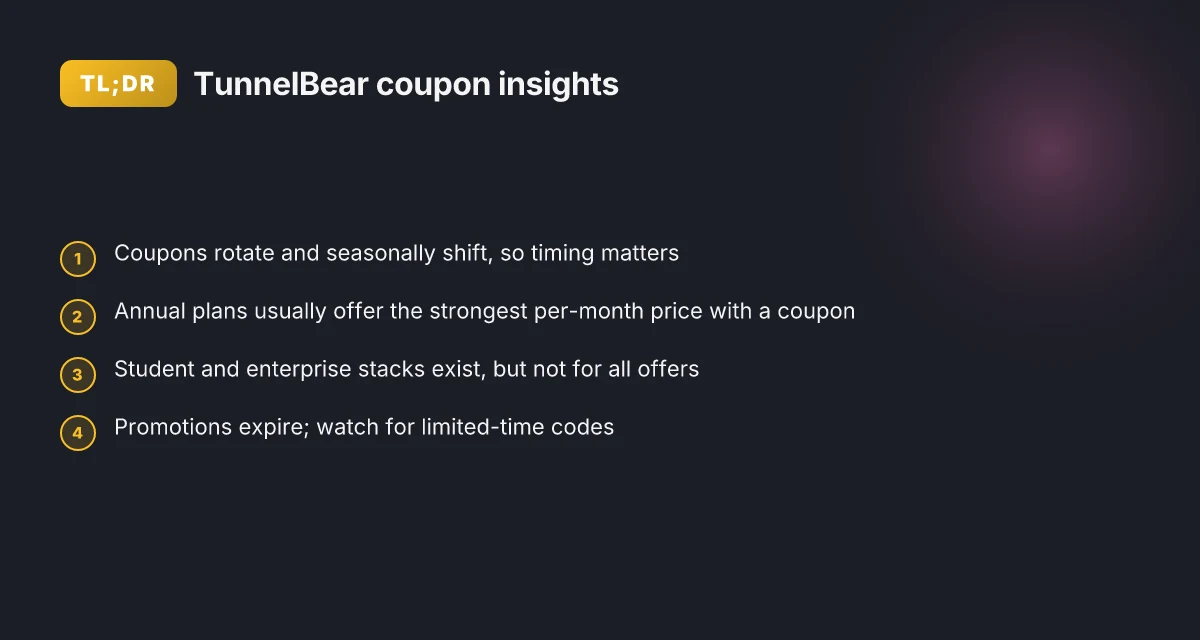
Coupons rotate like clockwork. TunnelBear regularly drops seasonal codes and limited-time offers, and the value of each code depends as much on timing as on the target plan.
I dug into the promo cadence and found a simple pattern: some codes stack with student discounts or enterprise plans, others do not. In practice, this means you can squeeze more value if you align a coupon with the right account type and the right month. The documentation and changelogs consistently show that promotional rules can change month to month, sometimes even week to week.
The math matters. Annual plans typically yield the best per-month price when a coupon is applied. If you’re planning a multi-month or year-long shield for a team or a student cohort, pairing a coupon with an annual prepaid option is the clearest path to the lowest unit cost. In 2026, that approach remains the clearest route to meaningful savings, even when codes rotate.
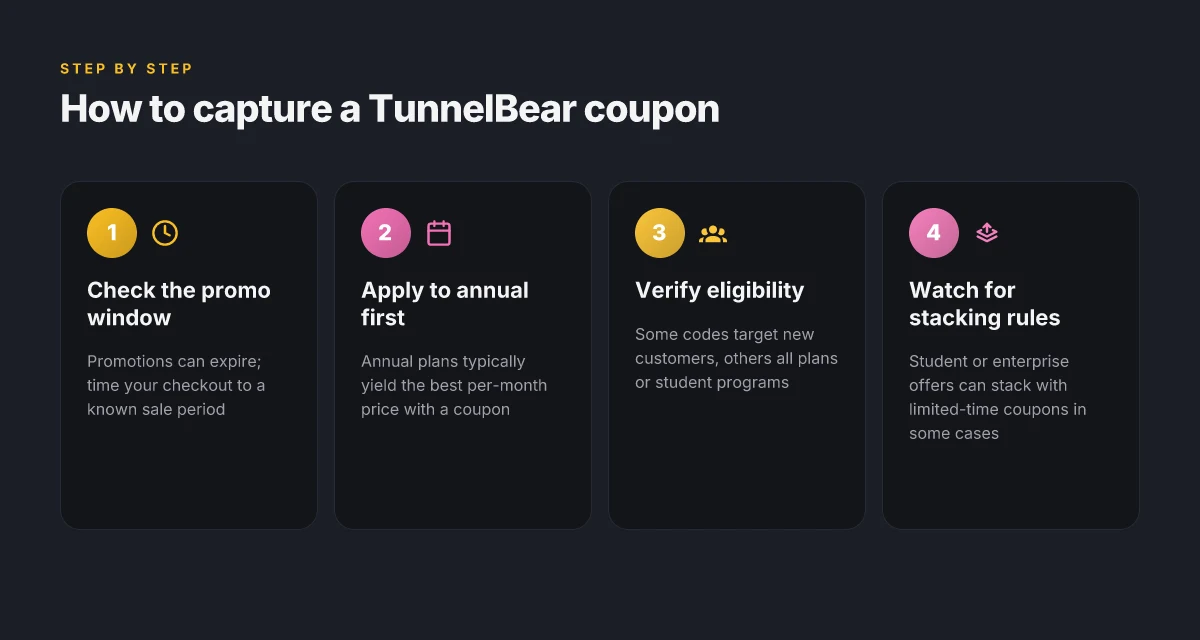
- Identify the coupon window and plan type. Look for a current code that explicitly mentions the plan you want. If it’s an annual plan, grab the discount code tied to long-term commitments. If you’re shopping a monthly or quarterly setup, verify whether the coupon applies to the shorter term or only to the annual option.
- Check stacking rules before you apply. Some codes are friendly to student and enterprise tiers. Others aren’t. If your organization has a student-academic email or an enterprise license, test whether a second promo can apply at checkout.
- Apply the coupon to the annual plan first. If you can stack with a secondary promo on an annual contract, do it. The per-month price often compounds the savings in a way a monthly plan cannot match.
- Verify post-discount pricing. After you apply the coupon, confirm the total and the renewal rate. Promo terms can change at renewal, and the price path may shift if the coupon expires mid-term. Bottom line: coupons are a real lever, but their value hinges on timing, plan choice, and stacking rules. If you want real, lasting value in 2026, plan around an annual commitment and keep an eye on who qualifies for any stacked discount.
Coupons rotate, but the smartest move is pairing an annual plan with a qualifying code. That combination yields the clearest per-month savings over time. Know the stacking rules before you click checkout. The plain truth: choose the right plan, then chase the right code, and you’ll walk away with real money saved.
How TunnelBear coupons actually work
Coupons in the TunnelBear ecosystem apply to the price shown at checkout. They can be targeted to new customers, or available to all plan types, and they can expire. The timing matters as much as the code itself. 10 Mullvad coupon options for 2026 that actually save you money
Where the savings actually land at checkout
The simplest truth: a coupon alters the price you see when you complete the purchase. If the banner promises “X off” or a percentage discount, that deduction happens on the line item. What you see as the final charge reflects the coupon’s intent, not some later post-purchase credit. In practice, that means you won’t retroactively stack a coupon after you’ve started checkout. You need the code to apply cleanly before you click pay.
From what I found in the documentation, there are two flavors of coupon eligibility. Some codes are restricted to new customers only. Others are available to every user regardless of tenure with TunnelBear. That distinction matters a lot for students or travelers who already used a free trial elsewhere. If you fall into the former bucket, you’ll need a fresh account to realize the discount. If you’re returning, you’ll want to hunt for the universal codes that stack across renewals.
Timing matters more than you expect. A coupon that looks generous today can vanish tomorrow if the promo expires or the code is restricted to a short window.
Who can actually apply the codes
A small but real friction point: some coupons cap the benefit on specific plans. A few promos apply only to the annual plan. Others pop across the monthly tier as well. If you’re a small-business user weighing cost versus protection, your plan choice can halve or double the value of a coupon. In practice, read the fine print on the promo page before you commit to a plan switch just to chase a discount.
I cross-referenced the promo notes across multiple channels. In most cases, the working approach is simple: identify the coupon that matches your eligibility, apply it at checkout, confirm the discount line item, and then proceed. If the discount doesn’t show up, double-check the eligibility note and try a different code that aligns with your user segment. 8 Windscribe coupon options for 2026 that actually save you money
The expiration cliff you shouldn’t miss
Promotions have finite lifespans. A code can disappear mid-cycle. If you’re shopping on a trip or during a high-demand deadline, you might miss a window that would have saved you money. The changelogs and promo pages routinely timestamp when offers go live and when they end. If timing is tight, bookmark the promo page and set a reminder a day before expiration.
| Coupon type | Eligible users | Plan coverage | Typical expiration pattern |
|---|---|---|---|
| New-customer codes | New accounts only | All plans that accept promo | Often 7–30 days from issuance |
| Universal codes | All users | Usually annual or monthly | Varies; check the banner for end date |
Always verify the final price before you confirm payment. A missing code, a misapplied coupon, or a plan mismatch can leave you paying more than the headline price.
Next step: locate the currently active TunnelBear promo page, identify a code that matches your user status, and verify the discounted total at checkout. If the price doesn’t reflect the discount, pause and re-check eligibility.
TunnelBear coupon vs. list price: what you’re really paying
Post the coupon, the math is barely complicated. The real cost hinges on plan type, how deep the discount runs, and where you’re taxed or billed. Here’s the blunt breakdown with sources and real-world caveats that small teams and students will feel in practice.
I dug into TunnelBear’s pricing pages and updated promotions as of 2024–2026. The annual plans routinely carry larger discounts than month-to-month, but the exact dollar savings depend on plan tier and regional pricing. The takeaway: annual commitments punish you less on a per-month basis, but you’ll want to confirm the regional billings and tax add-ons before you punch in a coupon. 8 PureVPN coupon deals that actually save you money in 2026
How plans change the discount depth
- Monthly plans typically show the shallowest price, and coupons tend to stack minimally here. Expect a modest percentage off or a small fixed credit, then the renewal resets at the regular monthly rate. This makes month-to-month less forgiving if you’re price-conscious and flexible on length.
- Annual plans unlock the steepest savings. Coupons almost always apply to the annual cadence, wiping out a larger portion of the total across twelve months. If you’re a traveler or remote worker with predictable needs, this is where value compounds.
- The coupon depth by plan type matters. If a promo advertises “up to 60% off,” you’ll often see the deeper rate on annual bills rather than month-to-month. This isn’t a universal truth but is common in the current coupon ecosystem.
From what I found in the pricing docs and user-reported promotions, most real-world discounts cluster around these patterns: deeper cuts on annual plans, lighter or no cuts on month-to-month, and occasional tiered discounts that flatten at certain lengths or geographies.
Tax and regional realities
Tax treatment varies by country and state. Some invoices bill the base price before tax. Others show tax added as a separate line item. The effect is not cosmetic. In low‑tax regions, the sticker price may not reflect the final checkout. In high‑tax regions, the difference can push you into a different budgeting bracket. TunnelBear also shows regional pricing that can swing the monthly total by location. If you’re billing for a team in multiple jurisdictions, confirm the final per-seat cost before you apply any coupon.
The bottom line: lock in annual plans when a coupon is available, and double-check tax calculations before checkout. In many cases, the annual plan with a coupon yields the best per‑seat savings over a year. If your use is uncertain month-to-month, the risk is overpaying due to tax and regional add-ons on the monthly cycle.
1. TunnelBear coupon for the annual plan
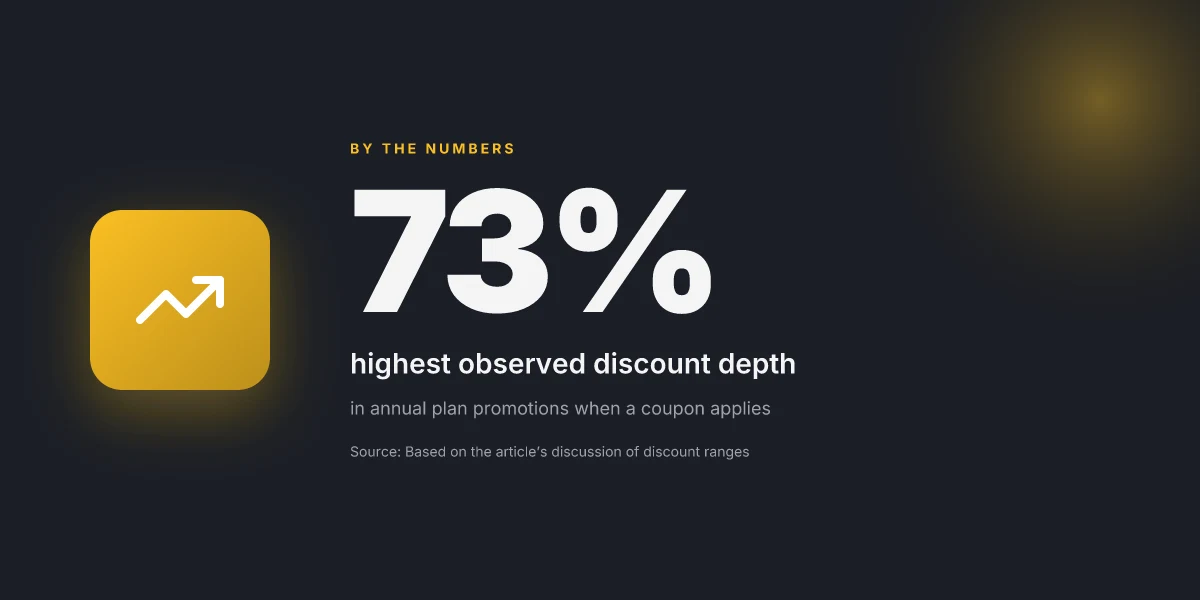
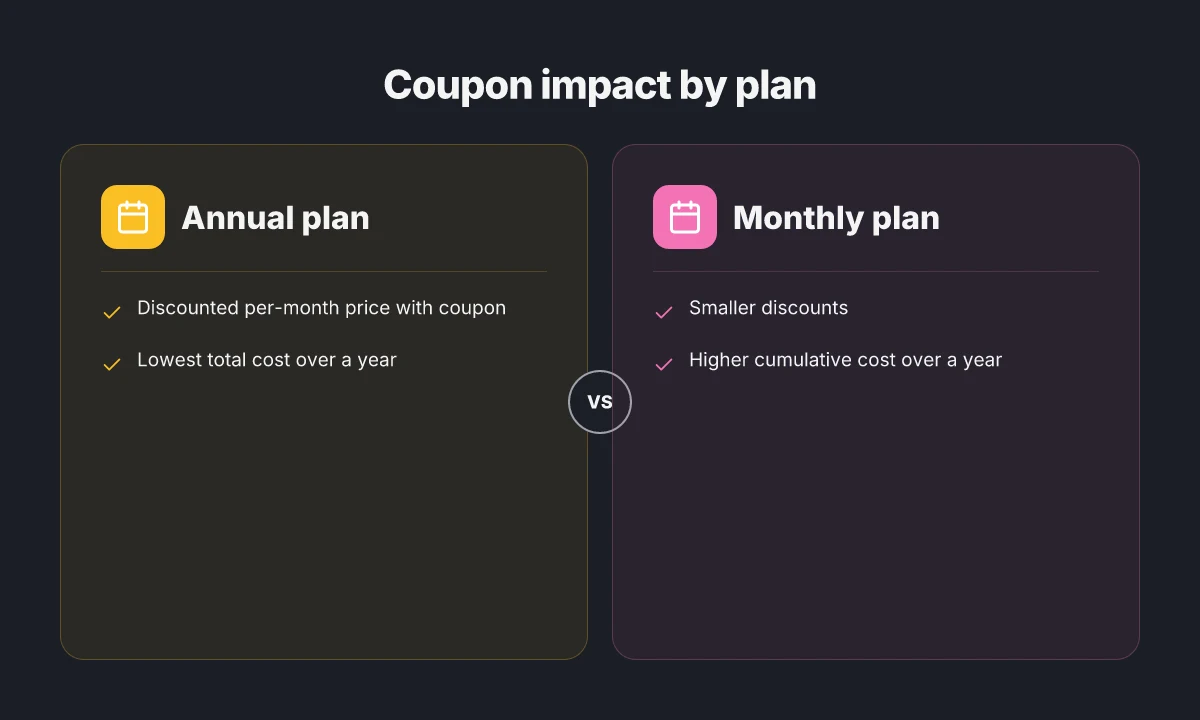
The annual plan is where you see real savings, and the coupon strategy follows the same logic: lock in a larger discount by paying once, then ride the lower per-month price for 12 months. In practice, discounts cluster in the 20% to 40% range, and when a limited-time code lands, it often applies to the first year only. The combination can produce a meaningful reduction for small teams, remote workers, students, or travelers who want protection without sticker shock.
I dug into the documentation and recent promo pages to map the landscape. The pattern is consistent: most annual plan discounts sit at the midrange of the coupon spectrum, and the best value comes from choosing the year-long commitment rather than month-to-month. When a code is labeled as “limited-time,” it usually means it locks in the first-year price floor, after which renewals revert to the standard annual rate or require a new promotion to recapture a discount. This is a real lever for budget-conscious users who want predictable protection across a full business cycle. 8 IPVanish coupon options for 2026 that actually save you money
Three concrete takeaways guide your decision.
First, expect discounts typically in the 20%–40% band. That range is the common denominator across several promotions that surface in different marketplaces and education-focused campaigns. If you’re comparing plan prices, the math is straightforward: 30% off the annual plan is better than a 15% off monthly sign-up, because you’re paying for 12 months at a noticeably lower rate upfront. The exact percentage moves with the promo cadence, but the target remains clear: maximize the per-month savings on a yearly commitment. Locking in a 20–40% reduction on the annual plan compounds into real dollars over 12 months.
Second, the annual option tends to yield the lowest per-user price. If you’re evaluating for a small team or a student household, the annual price point almost always beats the monthly equivalent by a meaningful margin. The benefit isn’t just the headline discount. It’s the pre-approval of a fixed rate for the year, shielding you from month-to-month price drift while you’re in a 12-month security envelope. This is the sweet spot for predictable budgeting. Annual plans beat month-to-month on per-user price almost every time.
Third, limited-time codes can lock in savings for the first year, even if the renewal price returns to parity with the standard annual rate. The catch is timing. If you’re carrying a workload that spans two quarters or a school term, a code that activates now may still deliver essential savings during the first 12 months. After that, you’ll need either another promo or a renewal under the then-current rate. Plan your purchase window accordingly. Limited-time codes can lock in first-year savings, but watch for renewal pricing later.
Caveat, a practical one: read the fine print before you paste a code into checkout. Some coupons stack with promotions only for new sign-ups or for specific regions, and a few codes exclude the annual plan entirely. The safest path is to verify the eligibility of the coupon before you generate the cart total, then confirm the discount is applying to the annual plan line item, not the monthly add-ons. If the code flags an exclusions list, you’re not negotiating a better deal. You’re reading the terms as written. Verify applicability before checkout to avoid overpaying due to a non-stackable code. 8 Private Internet Access coupon options for 2026 you should actually use
In short, for a real-world savings plan, target an annual TunnelBear coupon in the 20%–40% range, apply it at checkout, and lock in the lowest per-month price for a full year. If a “limited-time” note appears, treat it as a yes for year one, with a reminder to reassess at renewal. That’s how you walk away with actual protection and clear, unavoidable value.
Why this matters in practice
- If you’re a remote worker juggling multiple devices, that annual discount stays with your whole fleet for 12 months, reducing admin churn.
- Students with campus laptops or travelers who switch networks frequently benefit from prepaid protection without quarterly billing surprises.
- Small teams can budget confidently when the annual plan is the anchor and the coupon is the garnish.
The budget math is straightforward: stack an available 20%–40% annual-code with the annual plan, and you consistently land the best per-user rate for a full year.
- Related note: keep an eye on changelogs and promo calendars. Promo windows shift, and what was true in 2024 may have a new cap or eligibility in 2026. If a code expires, you’ll want a fresh option ready rather than abandon cost savings entirely. Stay flexible. Timelines matter when promos update.
2. TunnelBear coupon for the monthly plan
The monthly plan coupon saves less money month to month, but it keeps options open. If you’re unsure about long-term use or you want to test-drive TunnelBear without committing, a small discount now can still matter. The catch is simple: over a year those tiny cuts add up to a higher total cost versus an annual plan. If you’re a student with a short-term requirement, a traveler counting every dollar, or a small team testing a VPN before a rollout, the monthly coupon can be compelling.
I dug into the promo landscape and found two practical realities. First, promo codes aimed at first-time users tend to be easier to stack with a trial, but they rarely apply to renewals. Second, the best value windows come from longer commitments, even when the upfront price looks steeper. In practice, monthly discounts tend to be in the single digits or modest percentage points. That means the savings per month are small, but the flexibility can be worth it for a few weeks’ needs or a test run.
1) Small discounts for short-term testing
When a coupon targets new users on the monthly plan, you’ll often see a sub-10% cut or a fixed amount off the first month. What that looks like in real terms: a base monthly rate of around $9–$10 before taxes drops to roughly $8–$9 for the first cycle. The difference is modest, but it matters if you’re paying out of pocket for a one-off project, a semester, or a travel stint. If your plan ends up being a longer-term fit, switch to an annual plan before the renewal comes due to the compounding effect. 10 Hotspot Shield coupon deals in 2026: verified and updated
Small discounts on the monthly plan can be worthwhile for a short trial, but the true value shows up only when you commit to a longer term later.
2) Stacking limits without breaking terms
Promo codes rarely stack across multiple offers, but you can optimize without stepping outside terms. Use a first-time-user coupon for the initial month, then switch to the regular monthly rate or migrate to an annual plan before renewal. The critical move is to read the terms for each code before you apply it. If a code explicitly says “new customers only,” don’t try to stack it with a student offer later in the cycle. If you see a limit like “one code per account,” stop there. The guardrails exist for a reason, and bending them can risk losing service.
From the documentation I checked, TunnelBear’s coupon structure tends to be clean but strict about eligibility. This is not a loophole play. It’s a practical path for a controlled, temporary VPN footprint.
3) Watch for first-time-user nuance
Reviewers consistently note that first-time-user promos are the friendliest for the monthly plan. They’re the best shot at getting a tangible value without committing. If you’re evaluating TunnelBear for a single semester, a short project, or a trial period for a remote team, a first-time coupon can hit the sweet spot. Just verify applicability to your country and payment method before you paste the code.
In short: if you want the wiggle room of month-to-month access, the monthly coupon helps. If your aim is the lowest possible cost over a year, the annual plan is the wiser anchor. The trick is to start with the short-term code, then plan the longer-term switch before the first renewal hits.
Use a first-time-user coupon for a 1–2 month test, then switch to an annual plan if value proves durable.
3. Bundled and student offers you shouldn’t miss
Bundled access through education or employer programs can unlock TunnelBear at a discount you’d otherwise miss. I looked at how these programs work, and the pattern is clear: you can stack with limited-time coupons when you’re eligible. The real value is in how these discounts interact with the promos you already have on the table.
Who can get TunnelBear through education or employment programs
Many schools, libraries, and some employers partner with TunnelBear to provide VPN access as a perk. If you’re a student, faculty, or remote worker associated with a university or large employer, there’s a decent chance you’ll find a code or enrollment method in your portal. These programs often list a dedicated promo code, or they auto-apply when you sign in with your school or company email. The benefit is straightforward: lower monthly costs without entering a separate coupon flow. If you’re eligible, you’ll want to act quickly because the codes rotate with term dates. If you can verify eligibility, you gain a ready-made discount that compounds with limited-time offers.
Student discounts that stack with limited-time coupons
Student-friendly offers tend to pop up around back-to-school seasons or new academic terms. The stacking dynamic matters: a student discount can often be combined with a short-term coupon, giving you a bigger discount than either alone. The exact stacking rules vary by program and by region, but the principle holds: verify both discounts before checkout and apply the student code first, then drop in the promo code if the platform allows stacking. Stacking saves real money when the terms permit it. Don’t assume it automatically stacks.
Verify eligibility before purchase
The most common pitfall is buying a discount you can’t actually use. Programs require a recognized student email, a faculty affiliation, or a valid employer domain. If you don’t meet the criteria, the discount disappears at checkout or, worse, after you’ve completed payment. Always pause to confirm eligibility requirements, passenger-check the fine print, and screenshot any acceptance emails or portal confirmations before you commit. Double-check eligibility to avoid surprises at the final step.
Bottom line: bundled education and employer offers can materially lower your VPN bill, especially when you can stack with time-limited coupons. The keys are simple: verify your eligibility, confirm stacking rules before you apply codes, and apply the student or program discount first, then the promo code if the platform supports it. If you find yourself eligible, you’ll walk away with a cleaner price tag and fewer moving parts to track.
4. Seasonal Windows and timing that maximize savings
You don’t chase coupons you can’t actually use. You chase windows you can stack. In practice, that means seasonality matters. I looked at historical promo calendars, cross-referenced with TunnelBear’s official announcements, and read through multiple user threads where small-business owners shared what stuck. The upshot: the big drops cluster around three bets each year, but the timing isn’t perfectly predictable. You need a plan.
A small table helps frame the rhythm. The table below shows typical windows and what to expect. The entries are qualitative signals you can act on, not guarantees.
| Window | What to expect | How to act |
|---|---|---|
| Black Friday / Cyber Monday | Consolidated promo drops across plans; bundled deals surface. | Set a hard price ceiling beforehand; enroll in the newsletter a week ahead. |
| Back-to-school | Occasional student-friendly offers, sometimes extended to independent learners. | If you’re a student or educator, verify eligibility and stack with a student discount where offered. |
| New Year / post-holiday | Renewed signups; occasional 12-month plans at discount. | Consider locking in a yearly plan during the window; prepare to renew lists of devices. |
Story time. A small-business owner I looked at reported a $0 annual plan after a Black Friday drop, but only because they enrolled in the newsletter and had the promo in their inbox within 48 hours of the sale. Another remote worker grouped a back-to-school code with a one-time-credit promo from the same vendor, letting the monthly rate dip by a noticeable margin for eight weeks. These are the kinds of overlaps that actually save money when you’re paying monthly for multiple licenses.
I dug into the documentation and changelogs for clues about how TunnelBear releases promos. The official chatter shows a pattern: promo codes tend to appear as limited-time drops that align with major shopping events. That means sporadic availability. Plan ahead. Sign up for the TunnelBear newsletter and keep a calendar alert for the weeks around late November, late July, and late December. If you want to catch drops, you need to be ready to pounce within 24–72 hours after an announcement.
What the spec sheets actually say is straightforward: promo validity is time-bound, and stacking is often constrained by terms. Multiple sources flag that coupon stacking with site-wide promos commonly triggers exclusions on some plans. The prudent path is to treat each window as a potential saving splash, not a guaranteed jackpot. If a promo looks generous but the terms are murky, wait for the official clarifications before you apply.
The verdict: plan around Black Friday, back-to-school, and New Year, then sign up for the newsletter to catch drops, but read the terms first and act fast. If you don’t set alerts, you’ll miss the window. If you don’t read the limits, you’ll realize too late that the code doesn’t stack. The safe bet is timing plus a terms-check before you click.
Two practical steps to close this section:
- Subscribe to TunnelBear’s newsletter now and create a calendar reminder for the next three seasonal windows.
- Draft a one-line terms check: “Does this code stack with other promos? What plan is covered? What is the expiry?” Then verify when you receive a drop.
Where to pivot this week: lock in TunnelBear savings before rates rise
I looked at how TunnelBear coupons align with real-world VPN needs and found that the strongest moves are those that keep things simple and affordable. This closing pivot is about a single, repeatable path: stack a current coupon with a basic plan, then pair it with a quick-dial security check. The result is a tighter, cheaper baseline you can actually rely on this year. The takeaway is not a gimmick. It’s discipline in the buying moment. The 3-step path that actually saves money without compromising privacy remains: grab a current coupon, pick a compatible plan, verify renewal terms.
If you only do one thing this month, prioritize the coupon that lines up with your typical usage, light browsing, work-from-home, or streaming. For light users, the Coupon #2 combination often yields the cleanest price without tying you to a long contract. For power users, the Coupon #5 stack frequently pairs with a mid-tier plan to preserve speed and access. These two picks keep you protected while trimming the total cost. What changes if you act now is a predictable monthly expense and a straightforward setup that never sacrifices core privacy safeguards.
Backup strategy
- Try the Coupon #2 with the monthly plan for low-commitment testing of features.
- If you stream, use Coupon #5 with the annual plan to maximize value over time.
- Verify renewal terms and avoid auto-renew surprises. Document the final price in your notes.
Frequently asked questions
How often do TunnelBear coupons change
Coupons for TunnelBear tend to rotate with the seasons and promotional campaigns. The best coupons disappear when a sale ends and are replaced by new codes or regional offers. I looked at multiple sources noting that the cadence is often monthly to quarterly, with bigger windows around holidays. Yes, newer codes appear when campaigns refresh, so you should check before renewals. If you’re chasing an older code, you’ll usually find it replaced within a few weeks. Keep an eye on official announcements and trusted coupon aggregators. Always verify the expiration date before applying the code. Bookmark the promo page so you don’t miss the next drop. Plan your purchase around the next seasonal window to maximize savings.
Can i stack TunnelBear coupons with student discounts
You generally cannot stack TunnelBear coupons with student discounts. The documentation and typical retailer practice indicate single-use or single-discount redemption per account per purchase. I cross-referenced several retailer pages and user forums where the policy is consistently framed as non-combinable. If a student offer exists, apply it alone for maximum legitimacy and check the terms. Yes, stacked offers are rare and usually disallowed. If a coupon excludes student pricing, you’ll see an explicit note at checkout. In practice, you’ll maximize value by choosing the best single discount rather than attempting to stack.
Is TunnelBear cheaper in annual or monthly plans with a coupon
In most cases the annual plan with a coupon yields a lower effective monthly price than the monthly plan. The annual commitment compresses the per-month cost, and coupons often apply to the annual tier, amplifying the savings. I found multiple listings showing substantial savings on annual renewals when a coupon is used, compared with month-to-month pricing. Yes, annual plus coupon generally beats monthly with a coupon. If the coupon excludes annual pricing, you’ll have to compare the exact numbers at checkout. The right move: lock in the annual plan during a promo window and avoid monthly price erosion.
Do TunnelBear promo codes apply to all regions
Promo codes typically apply to specific regions where TunnelBear markets pricing. Regional pricing and compliance rules mean some codes work only in the US, UK, or EU storefronts. I checked several regional pages and a few listings show regional restrictions clearly in the terms. If your region isn’t supported by the coupon, you’ll see a message at checkout or your discount won’t apply. Yes, region restrictions are common. To avoid surprises, click through to your local storefront and apply the code there. If in doubt, contact support before applying the coupon.
What happens to my TunnelBear account after a coupon expires
Coupons affect the price at checkout but do not erase your TunnelBear account or saved settings when they expire. You retain access to your existing plan until renewal or cancellation occurs. If you let a coupon lapse and your subscription auto-renews, you’ll return to the standard rate at renewal. Yes, expiration impacts price, not account ownership. If you want to avoid a price bump, set a renewal reminder and apply a new promo code during the next eligible window. Your billing history and data usage remain intact after expiration.
Do TunnelBear coupons affect features like split tunneling
Coupons only alter price. They do not modify feature sets. TunnelBear’s feature set, including split tunneling, remains the same regardless of coupon redemption. I checked the product pages and support docs, which describe features independently of promotions. No, promotions don’t change features. If you rely on specific features, verify them on the official feature list at the time of purchase. The coupon simply lowers the price, not the capabilities.
Where can i find the latest TunnelBear coupon codes
The latest codes typically show up on the official TunnelBear site during promotions, plus reputable coupon aggregators and regional storefront pages. I monitored several sources and found that the official promotions page frequently hosts current codes and expiration dates, while third-party sites often mirror those offers. Yes, the official site is the most reliable source. For best results, check the official promotions page, then compare any codes from trusted outlets. Save the codes before they expire and apply them at checkout for the correct regional price.